

To get the right efficient lighting for your home, you’ll need to know how to pick the right brightness, color and bulb type from among the many LED options available.
Updated
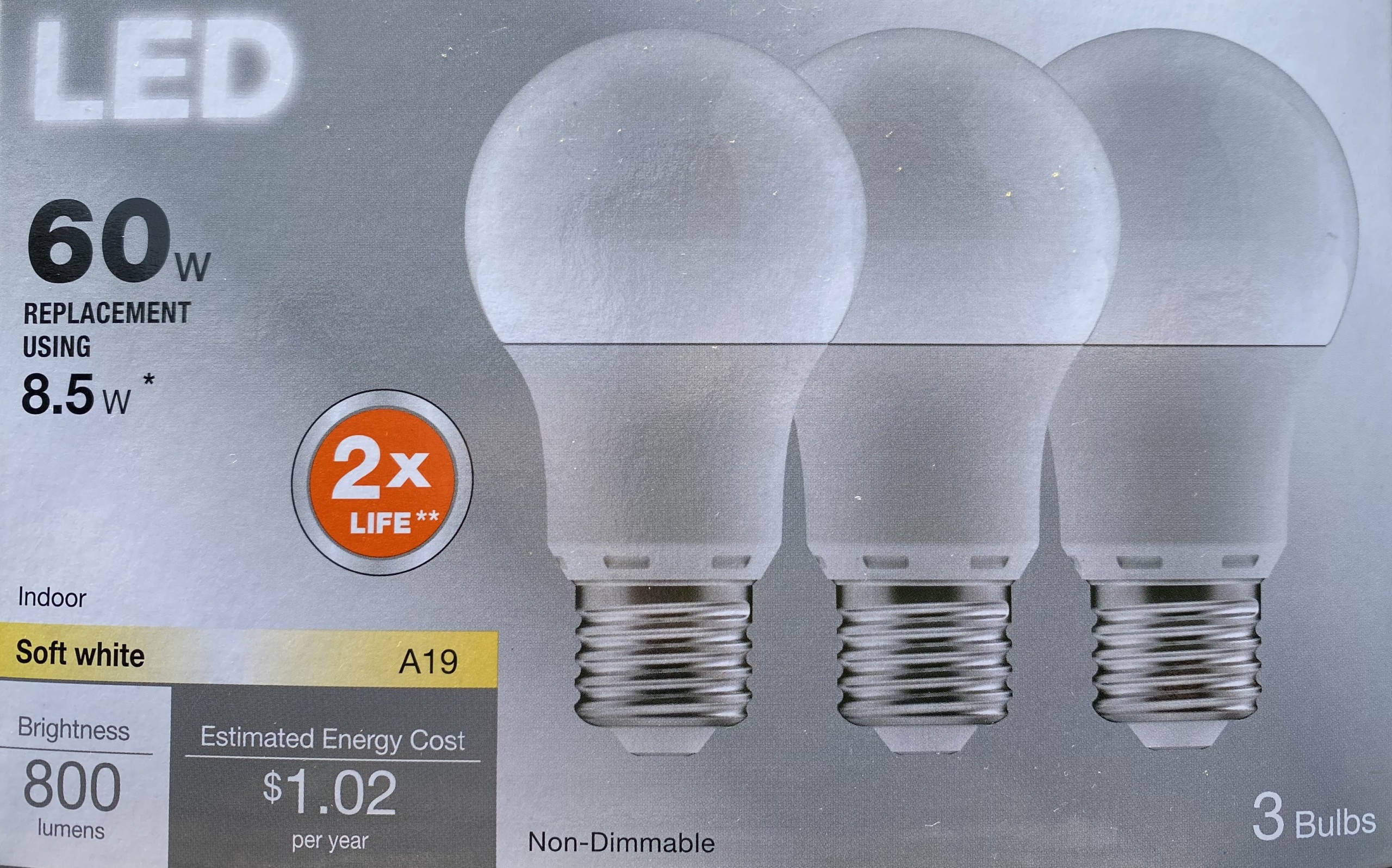
Light bulbs containing light-emitting diodes are increasingly common on store shelves, replacing fluorescent and incandescent bulbs. Thankfully, LEDs are much more efficient than other options, allowing you to use less energy and reduce your utility bills. More efficient lighting also means less need for fossil fuel power plants, reducing the damage that electricity generation causes to our health and environment.
LEDs are quite different from incandescent and fluorescent light bulbs, and provide consumers with a wide array of choices that can be tailored to their specific lighting needs. There are even “smart” LEDs you can even control from your phone, adjusting color, brightness, schedules or even syncing them to music. Here are some tips to help you pick the right bulb:
The first metric to know about when buying LED bulbs is lumens. Lumens are a measurement of brightness (more lumens = higher brightness), and the first thing you should look for to decide if a given LED will meet your needs.
Less-efficient bulbs, like incandescents and fluorescents, get brighter as they use more power (which is why we often describe the brightness of incandescent bulbs in watts, a unit of power).
LEDs, on the other hand, don’t necessarily require more power to be brighter, so they are measured with lumens. Manufacturers are required to label LEDs with their brightness in lumens, so this should be easy to find on the box. Before buying an LED, take note of the wattage or lumens of the bulbs you’re replacing, and think about whether you want the space to be lit more or less brightly.
The Department of Energy has compiled a rough guide of LED brightness and how it compares to incandescents based on watts:

The second, crucial aspect of LEDs is their color. While incandescent bulbs are yellow and warm (because, remember, they’re literally glowing with heat) and fluorescent bulbs are generally made to be somewhat yellow, LEDs can come in a much wider range of colors. This gives you much more control over the light and color you want, but it can be confusing, since the other technologies don’t have these options. Kelvin (abbreviated K) is the way the color of LEDs is specified, with lower Kelvin values meaning light that is warmer (more yellow and orange) and higher Kelvin values indicating cooler, bluer light. CNET, Philips, GE and others have guides to choosing the right color of light, but in general:

In addition to listing brightness (in lumens) on LED packaging, manufacturers are required to show LEDs’ color (in Kelvin) on the box. Make sure you know where you’re going to put the bulb and what you want to use that space for, and/or try some of the LEDs whose color you can control from a smartphone.

Color-rendering index (CRI) is a measure of how the light from a bulb affects the appearance of colors of illuminated objects. CRI is measured on a scale from 1 to 100, with higher values indicating that objects will look more like they do under natural sunlight. Manufacturers are not required to publicize the CRI of an LED, though they often do, and it isn’t always the most useful or reliable data point because it is based on a small number of color samples and the results are averaged. Though you can’t rely on CRI too much, look for higher CRI values if possible (above 90 is better) and consider checking customer reviews for comments about color rendering.
Note that LED bulbs may dim with age, with both their quality and intensity declining over time. This might mean you need to replace an LED bulb before it dies if you want to maintain a particular light quality.
LEDs – or light-emitting diodes – pass electrons in one direction between two different kinds of semiconductors (similar to what makes up transistors in electronics), producing light. They generate much less heat, produce light more efficiently, don’t rely on a toxic element, and can last much longer than either incandescents or fluorescents. In contrast, incandescent bulbs run electricity through a thin filament, and the electrical resistance of the filament causes it to heat up and glow, producing some light. That’s why incandescent bulbs use so much more power (watts) than LEDs. Fluorescent bulbs are more efficient than incandescent bulbs, but they contain gaseous mercury, a highly toxic element that presents health and environmental risks.
There are lots of different kinds of dimmer switches that you might have in your home, from those that vary voltage to those that flick power on and off rapidly and many others. While incandescent bulbs generally work with all different types of dimmers, LEDs are more complicated: for example, they have a minimum voltage needed to function at all, and are not always built to handle rapid on-off cycles. LEDs can be made to be dimmable, but aren’t always compatible with every type of dimmer.
“Smart” LEDs (whose color and brightness can be controlled by a remote or a smartphone) are generally not compatible with any kind of dimmer. When an LED is used in an incompatible dimmer circuit, it can flicker, hum, buzz, not work below certain thresholds, or have a significantly reduced lifespan.
If you’re getting LEDs for a house or room without dimmers, you can get whatever bulb you want, but if you want to be able to dim your LEDs, the following tips can help you avoid problems:
Tips for buying dimmable LED bulbs
While LEDs produce much less heat than incandescent or fluorescent lights, they do produce some. Basic LEDs are designed, however, to conduct that heat towards the base of the bulb and dissipate it from there (whereas, say, an incandescent bulb dissipates heat from the bulb itself). That means that if there is no way for the base of the LED to dissipate heat (e.g., if it’s in an enclosed fixture like a fully enclosed porch lamp or a recessed dome light), it could overheat and burn out. Luckily, some LEDs are designed to be used safely in enclosed fixtures. To avoid overheating problems, for any enclosed fixtures – recessed dome lights, enclosed porch lights, or any other fixture where there won’t be a lot of ventilation or heat dissipation – use LEDs that are designed for enclosed fixtures.
Some LED fixtures are sold with bulbs that are neither removable nor replaceable. That can make them easy to install, but it means that the whole thing becomes non-functional or much less useful if even a single piece stops working. That means you might end up getting rid of pieces that are perfectly good and replacing more than is necessary, which is a waste of your money and of energy and resources. If possible, try buying LED bulbs to go into your current fixtures, or buying fixtures with replaceable bulbs.
Any LED bulb you find will likely use a lot less power than the incandescents and fluorescents you’re used to. That being said, there is still variation in power consumption between LEDs. If you’re deciding between two different LED bulbs that are equivalent in lumens, Kelvin and CRI (and, if you’ve tried to dig further, customer reviews), you may want to go with the bulb that uses less power (measured in watts), as that means you’ll use (and pay for) less electricity.
In short, LEDs deliver energy and cost savings for you, pollution savings for the planet, and much more control over how you light up your life.
Former Policy Analyst, Frontier Group
Senior Director, Campaign for 100% Renewable Energy, Environment America
Johanna directs strategy and staff for Environment America's energy campaigns at the local, state and national level. In her prior positions, she led the campaign to ban smoking in all Maryland workplaces, helped stop the construction of a new nuclear reactor on the shores of the Chesapeake Bay and helped build the support necessary to pass the EmPOWER Maryland Act, which set a goal of reducing the state’s per capita electricity use by 15 percent. She also currently serves on the board of Community Action Works. Johanna lives in Amherst, Massachusetts, with her family, where she enjoys growing dahlias, biking and the occasional game of goaltimate.